

05 / 05 / 26
Decree amending, supplementing, and repealing various provisions of the Federal Labor Law regarding the reduction of working hours.
MEXICO CITY, MEXICO, May 5th, 2026 – On May 1, 2026, the “Decree amending, supplementing, and repealing various provisions of the Federal Labor Law regarding the reduction of working hours” (the “Decree”) was published in the Official Gazette of the Federation, in line with the recently published constitutional reform, marking one of the most significant structural changes to the Mexican labor regime in recent decades. The Decree entered into force on the same day of its publication; however, its implementation will be gradual pursuant to its transitory provisions.
Progressive reduction of working hours
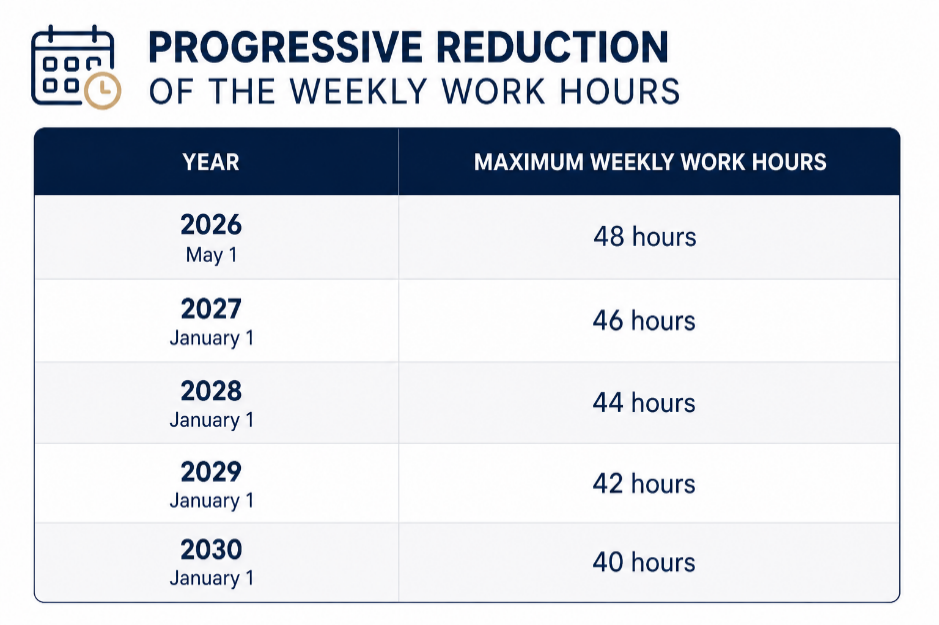
The transitory articles of the Decree provide for a new framework establishing a phased transition toward a maximum workweek of 40 hours, through a reduction of two hours per year starting in 2027, in accordance with the following table:
Notwithstanding the reduction in weekly working hours, the daily working hour limits established by the Federal Labor Law (the “Law”) remain unchanged (maximum of 8 hours for daytime shifts, 7 hours for nighttime shifts, and 7.5 hours for mixed shifts).
The Decree allows the parties to agree on flexible weekly distribution schemes, provided that the limits established in the Law and the Decree are respected, thereby opening the possibility to redesign shifts and hybrid models.
The obligation to grant at least one day of rest with full pay for every six days worked remains in force, preferably on Sunday, while maintaining the Sunday premium payment in favor of employees at the same previously established rate (25%). Likewise, the Decree expressly provides that the reduction of working hours referred to therein may not result in a decrease in employees’ wages, salaries, or benefits.
New overtime regime
The reform introduces new criteria for overtime that will also enter into force gradually:
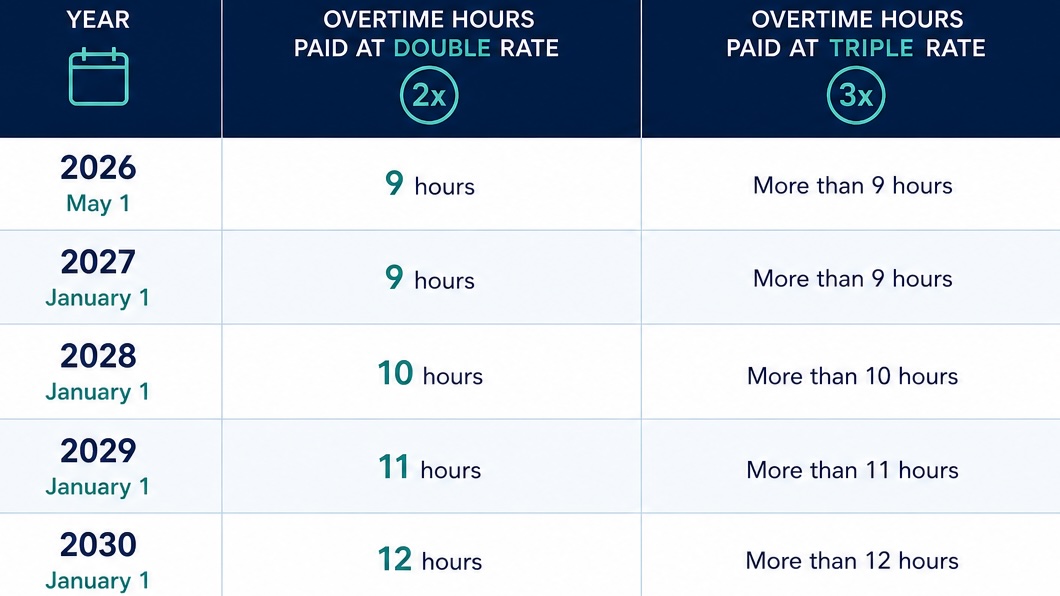
- The maximum weekly overtime that employees may work will increase gradually at a rate of one hour per year starting in 2028, such that by 2030, the weekly overtime limit will be 12 hours, as provided in the Decree (maximum of 4 overtime hours per day, for up to 4 days per workweek). Such hours must continue to be paid at a rate of 100% above ordinary wages (double pay).
- Additionally, the Decree provides that overtime hours exceeding the aforementioned weekly limit (12 hours) must be paid at a rate of 200% above ordinary wages (triple pay).
- Notwithstanding the foregoing, the sum of ordinary and overtime hours in a single day may never exceed 12 hours.
- Exceeding these limits will constitute a direct violation of the Law.
- The prohibition against inhumane working hours is maintained, understood as those that are clearly excessive given the nature of the work.
- The obligation to provide employees with at least a half-hour rest period to rest or eat during a continuous workday is also maintained.
This is explained in the table below:
Electronic working hours record obligation
The Decree introduces a new obligation for employers to electronically record each employee’s full working hours (from start to finish) and to make such information available to the authority upon request.
- Effective date: January 1, 2027.
- Sanctions: from 250 to 5,000 UMA for failure to comply with this obligation.
The Ministry of Labor and Social Welfare (STPS) will issue general provisions regarding the scope and exceptions of this obligation before January 1, 2027, anticipating an environment of increased digital oversight. The electronic record will constitute full evidence in court proceedings.
Comprehensive reconfiguration of the labor model
The transition to a 40-hour workweek is not only a regulatory obligation; it is a structural change that requires informed decision-making and precise execution.
At SMPS Legal, we believe this reform represents a turning point in the evolution of the Mexican labor market. Companies that adopt a proactive approach—combining compliance, operational efficiency, and strategic redesign—will be better positioned to mitigate risks and capitalize on opportunities in this new environment.
Key challenges include the following:
- Redesign and adjustment of shifts and operational coverage.
- Review of compensation schemes and overtime control.
- Implementation of digital labor compliance and time-tracking systems.
- Evaluation of productivity under new time constraints.
If you would like to assess the specific impact on your operations or develop an implementation strategy, our team is available to assist you.