

07 / 31 / 26
TECHNICAL MEMORANDUM: A detailed analysis of the addition of Rule 3.5.23 to the First Resolution of Amendments to the 2026 Miscellaneous Tax Resolution.
MEXICO CITY, MEXICO, July 31st, 2026
1. Background and Commercial Context
On July 9, 2026, the Mexican tax authorities published the First Resolution of Amendments to the 2026 Miscellaneous Tax Resolution, introducing several changes to the Mexican tax framework. Among the most relevant is Rule 3.5.23., which provides a tax withholding relief mechanism designed to improve cash flow efficiency for certain structured investment vehicles.
Under Article 54 of the Mexican Income Tax Law (LISR), financial institutions are generally required to withhold income tax on interest payments. Historically, this withholding has created temporary cash flow inefficiencies for tax-exempt investors by generating refundable tax balances. The new rule addresses this issue by allowing trusts issuing Investment Project Trust Certificates (CerPIs) to avoid income tax withholding on the portion of the investment corresponding to pension and retirement funds qualifying under Article 79, Section XXI of the LISR. As a result, the measure enhances the immediate returns generated by these investment vehicles while promoting the efficient allocation of capital toward long-term investment and development projects in Mexico.
1. Scope of Application (Eligible Parties)
The relief applies exclusively where the following four parties are simultaneously involved:
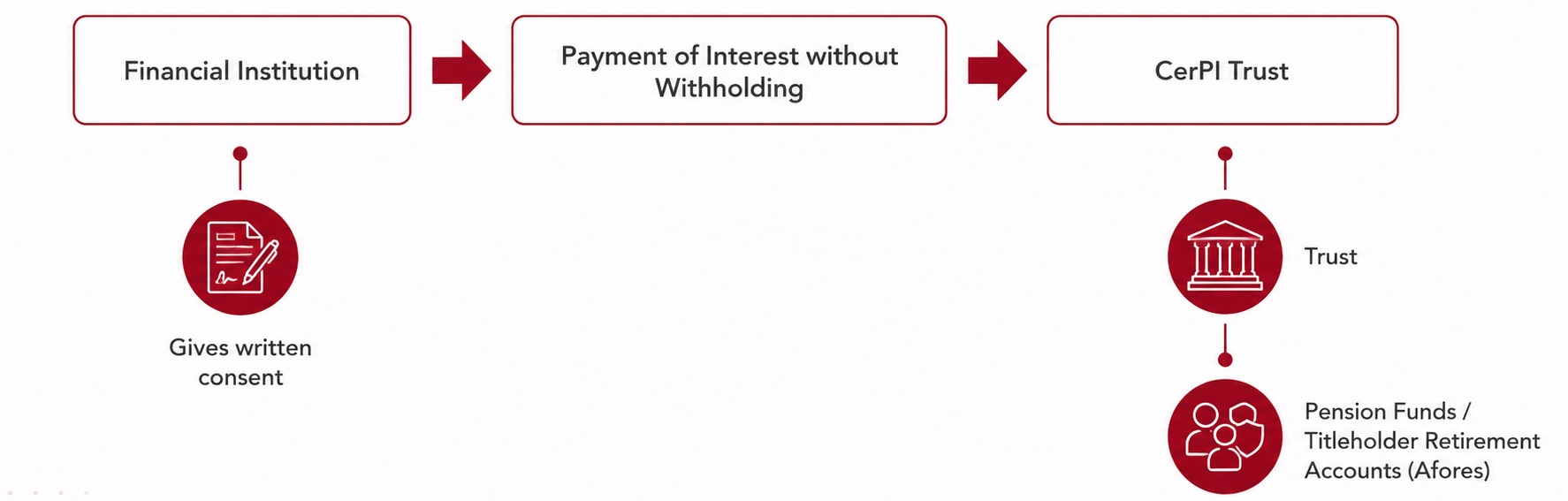
- Paying Financial Institution: A regulated financial institution responsible for making interest payments to the trust. Under Article 54 of the Mexican Income Tax Law (LISR), it is generally required to withhold income tax on such payments.
- Issuing Trust (CerPI): A trust that does not carry out business activities (as defined under Rule 3.1.14. of the RMF) and serves as the issuer of Investment Project Trust Certificates (CerPIs), duly authorized and listed in accordance with the regulations issued by the Mexican National Banking and Securities Commission (CNBV).
- Trustee: The trustee, acting on behalf of the trust, is responsible for administering the compliance process, filing the required notices with the Mexican Tax Administration Service (SAT), maintaining the mandatory ownership records, and, where applicable, assuming substitute liability for the payment of any tax that should have been withheld.
- Exempt Certificate Holders: Only legal entities qualifying under Article 79, Section XXI of the LISR, namely pension and retirement funds established by employers or through collective retirement arrangements, are eligible. These entities must hold legal ownership of the CerPIs giving rise to interest and all rights attached thereto.
2. Operational Requirements (Compliance Checklist)
To qualify for and apply the proportional withholding tax exemption, the trustee must complete the following steps, in the order set out below, prior to any interest payment:
- Private Notice and Consent: Pre-Operational Phase Between the Trustee and the Financial Institution.
The trustee must notify the financial institution in writing of its intention to apply the relief provided under Rule 3.5.23. The notice must specify, to four decimal places, the percentage of the trust’s capital held by qualifying pension funds under Article 79, Section XXI of the Mexican Income Tax Law.
The financial institution must then provide its written consent confirming that it agrees not to withhold tax on the corresponding interest payments.
- Administrative Filing Before the Mexican Tax Authorities (SAT): Filing 97/ISR.
Once the financial institution’s written consent has been obtained, the trustee must submit the “Notice Requesting Non-Withholding for Trusts Issuing Investment Project Trust Certificates (CerPIs)” (Filing 97/ISR of Annex 2) before the Mexican Tax Administration Service (SAT).
The filing must include:
- The trustee’s written notice.
- The financial institution’s signed written consent.
- Delivery of the SAT Acknowledgment: Formal Authorization for Non-Withholding.
The trustee must obtain the official acknowledgment issued by the SAT confirming receipt of the filing and formally provide it to the paying financial institution. Upon receipt of such acknowledgment, the financial institution is legally authorized to refrain from withholding tax on subsequent interest payments.
(iv) Ongoing Recordkeeping and Compliance Obligations
The trustee is required to:
- Maintain a special registry reflecting ownership of the CerPIs.
- Retain all supporting documentation in accordance with Article 28 of the Mexican Federal Tax Code.
- Promptly notify the financial institution in writing and update the filing before the SAT whenever there is any change in the ownership of the certificates.
(v) Allocation of Responsibilities and Tax Risk
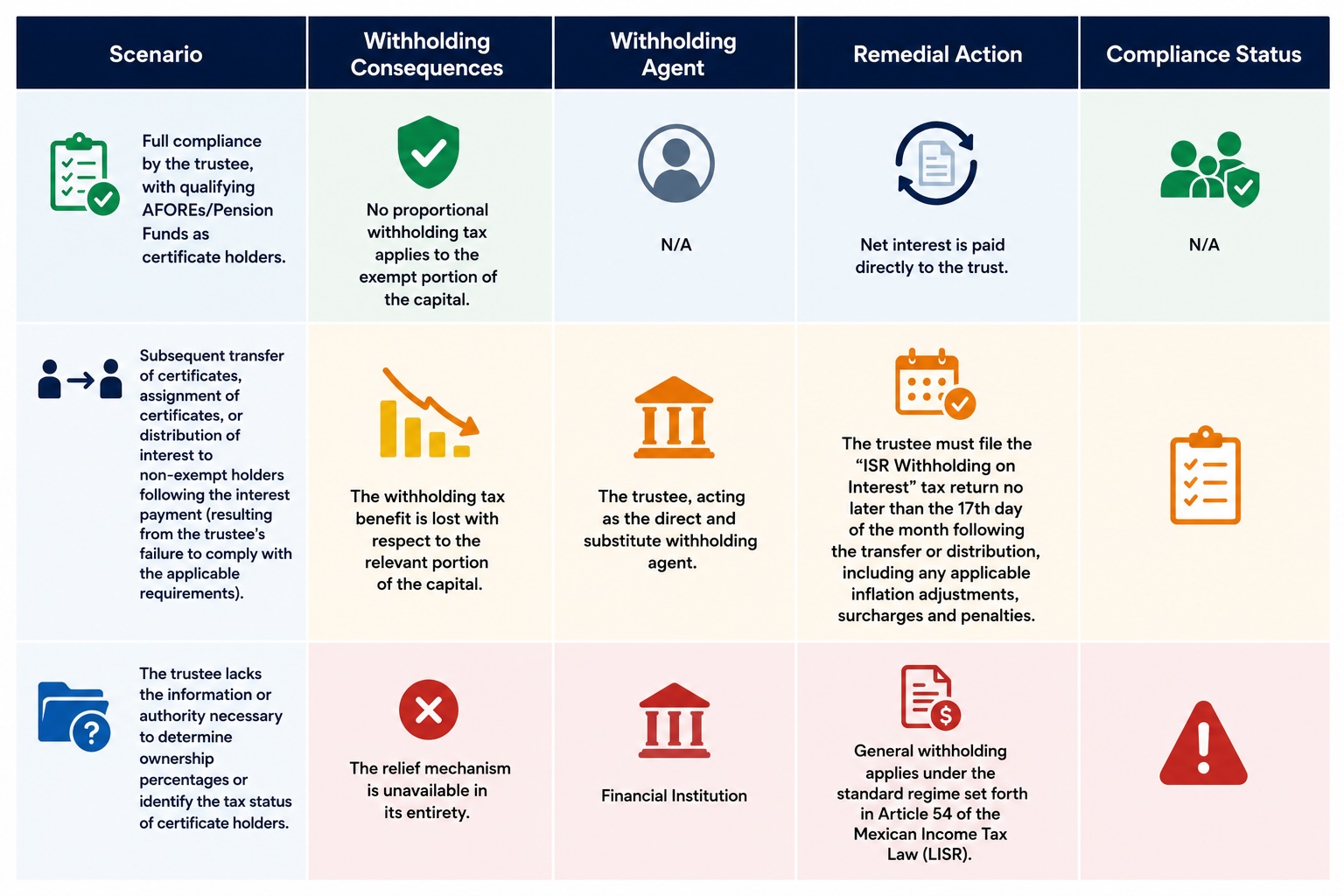
The framework establishes a strict substitute liability regime under which the trustee may assume liability where changes in certificate ownership or non-compliance with the applicable requirements result in the improper application of the non-withholding mechanism:
3. Issuance of Electronic Tax Receipts (CFDIs)
If the trustee fails to comply with the requirements of Rule 3.5.23. and is consequently required to remit the income tax after the applicable due date, the following additional obligation will arise:
Issue the corresponding CFDI for tax withholdings and payment information to each trust beneficiary (investor) with respect to whom the income tax withholding was ultimately applied
4. Recommendations and Next Steps for Clients
From a tax advisory perspective, we believe this new rule presents a significant opportunity to enhance the immediate yield of investment projects financed through CerPIs by eliminating unnecessary income tax withholding for qualifying investors.
However, the benefit is contingent upon robust trust governance and strict compliance with the operational requirements established by the rule.
Accordingly, we recommend implementing the following measures:
1. Review of Certificate Holders
Verify that investors claiming the exemption effectively qualify under Article 79, Section XXI of the Mexican Income Tax Law (LISR) and maintain up-to-date tax registration certificates and supporting documentation evidencing their exempt status.
2. Amendments to the Trust Agreement
Review and, where appropriate, amend the trust agreement to strengthen the trustee’s authority and obligations, ensuring it has the contractual right to obtain timely information regarding transfers or assignments of CerPI certificates. This will help prevent the loss of the withholding relief resulting from incomplete or outdated ownership information.
3. Automated Compliance Process for Notice 97/ISR
Implement an automated communication protocol among the trustee, the paying financial institution, and the SAT to promptly address changes in the secondary market ownership of CerPIs. This process should facilitate the timely updating of Notice 97/ISR before each applicable interest payment date, thereby preserving the availability of the withholding relief.